From Babylon to Bubble Baths: The History of Soap
September 26, 2025
Did you know that our logo is shaped like a classic bar of soap? Yep, a little nod to the craft we honor every day. In fact, soap is hailed as one of the most important inventions of all time, revolutionizing public health, reducing disease, and enabling modern societies to thrive. It should come as no surprise to you then that National Soapmaking Day—Sunday, September 28, 2025—is a big deal here at Two Bettys. In celebration, we’re lathering up some fun and dishing the dirt on the history of soap!
What’s in a Name?
Let’s dive into the origins of soap, starting with its name.
Linguists trace the word “soap” back to the Latin sapo, a term used in ancient Rome to describe a mixture of animal fat and ashes. Some historians believe the word’s roots go even deeper into folklore. According to legend, it was named after Mount Sapo, a mythical site where animal sacrifices took place. Rainwater would carry fats and ashes into the river below, creating a slick substance with surprising cleaning power.
Soap Appears on the Scene
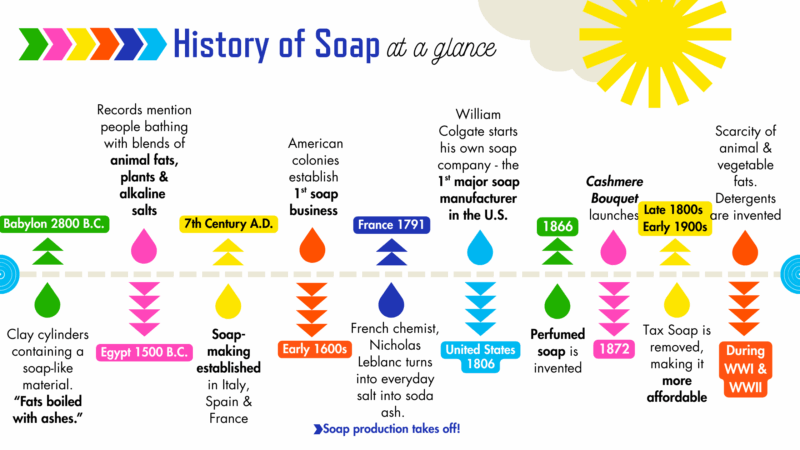
Fast forward 1300 years to 1500 B.C., when ancient Egyptian records mention people bathing with blends of animal fats, plant oils, and alkaline salts—early evidence of soap-like cleansing practices.
By the 7th century A.D., soapmaking became established in Italy, Spain, and France, thanks in large part to their abundant supply of olive oil.
By the early 1600s, the American colonies had established their first soap business. In fact, Benjamin Franklin’s father, Josiah, was one of America’s first soap boilers.
The Rise of Soap Giants
In 1791, French chemist Nicholas Leblanc shook up the world of soap-making by figuring out how to turn everyday salt into soda ash. This new ingredient, when blended with fats, created a reliable way to produce soap on a much larger scale. Thanks to Leblanc’s discovery—and the rise of new factory power—soap production took off, becoming one of America’s fastest-growing industries by the mid-1800s.
Another key figure in soap’s history is William Colgate, who started his own soap company in 1806.
Not only was his company the first major soap manufacturer in the U.S., but it also pioneered the idea of perfumed soap in 1866. The launch of Cashmere Bouquet in 1872 was a game-changer—introducing a product that was both cleansing and indulgent. Remarkably, it’s still being made today, proving that some classics really do stand the test of time.
As chemistry advanced, so did the understanding of ingredients and processes. During the Civil War, there was an increase in demand for soap and water for sanitary reasons. By the late 1800s and early 1900s, the tax on soap was removed in the U.S. and many countries around the world, making it easier for the general population to obtain it.
Because necessity is the mother of invention, the scarcity of animal and vegetable fats during WWI and WWII pushed chemists into their labs. Their mission was clear: create a chemical alternative to the world’s most in-demand cleaning and sanitation product…and detergents were born.
Today, detergents share shelf space with old-fashioned fat-and-lye soaps in households across America.
Fat, Soap’s Unsung Hero
While fragrances and packaging seem to get all the attention, the star of the show in soap-making has always been fat. Traditional soap is created when fat interacts with an alkali, like lye. Modern soapmakers typically use fats that have been processed into fatty acids, making the end product purer and cleaner. Depending on the recipe, vegetable oils such as olive oil, palm kernel oil, and coconut oil are also common ingredients. The result? A smooth, effective cleanser with fewer impurities and a better lather.
A Billion-Dollar Industry
It’s no surprise that soap has bubbled into big business. In fact, the soap and cleaning compound manufacturing industry in the U.S. is estimated to generate $47.7 billion in revenue in 2025. With the rise of artisan makers, specialty soaps, liquid hand soaps, and a plethora of detergents, the soap industry continues to grow and is powerful enough to fuel an entire industry.
Beyond Clean: Soap’s Other Selling Points
Soap isn’t just about cleanliness—it’s also about comfort. Many bar soaps contain glycerin, a natural byproduct that’s excellent for skin hydration. For people with conditions like eczema or even just dry skin, glycerin soaps can make a noticeable difference. In that sense, soap isn’t just a cleanser. It’s also a form of skincare, offering benefits that go far beyond the surface.
While some soaps are made to hydrate and soothe, others are designed to defend. This includes antibacterial soap, which has grown increasingly popular in recent years. Generally in liquid form, antibacterial soaps kill germs on contact—a great way to fend off sickness and support overall hygiene during cold and flu season.
Luxury to the Last Bubble
Of course, not all soap is about practicality. Some bars are made for prestige. Consider one of the world’s most expensive soaps: a single bar priced at a staggering $2,800. Produced in Lebanon by a family-run business, this soap is infused with actual gold and diamond powder. You probably don’t want to keep this one next to your kitchen sink…but it proves that soap can be both functional and luxurious!
A Lasting Legacy
From clay pots in ancient Babylon to luxury bars infused with gold, tracing the history of soap takes us on a remarkable journey. Soap has shaped industries, transformed personal hygiene, and even offered comfort to dry, irritated skin. The next time you lather up, remember: soap isn’t just about getting clean—it’s a connection to a tradition as old as civilization itself. And no matter how advanced or luxurious it becomes, one truth remains timeless: nothing beats that fresh, clean feeling.
If you’re looking for some good, clean fun, follow us on Instagram—a place we love to share fun facts and cleaning hacks!
Not all soap is created equal. Many of today’s soap formulations and detergents contain toxic ingredients that can harm our bodies and pollute streams, rivers, and lakes. Learn how to spot toxic ingredients in household cleaners and choose green cleaning products.